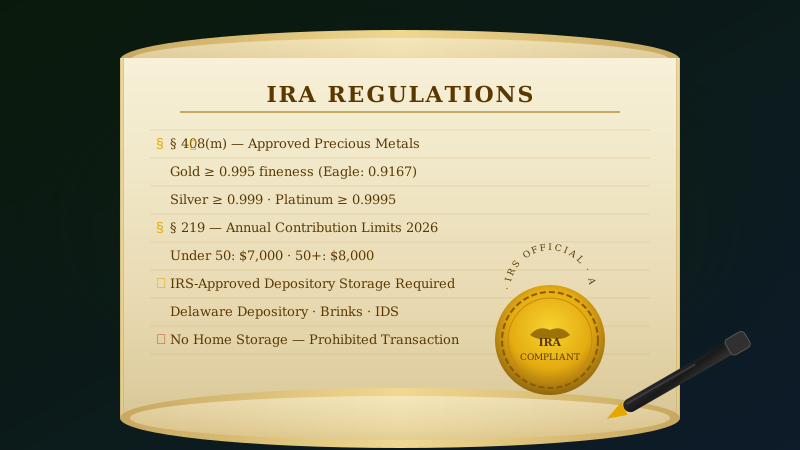
 IRA rules and regulations for precious metals
What Is a Gold IRA?
A Gold IRA holds physical precious metals — gold, silver, platinum, or palladium — at an IRS-approved depository under IRC §408(m) authority, operating as a self-directed IRA (SDIRA). It is not a separate IRA type: it is a standard Traditional or Roth IRA with precious metals as the asset class, governed by the same contribution limits, distribution rules, and tax treatment.
Traditional IRA vs. Roth IRA vs. Gold IRA: Side-by-Side Comparison
| Feature | Traditional IRA | Roth IRA | Gold IRA |
|---|---|---|---|
| Asset type | Stocks, bonds, funds | Stocks, bonds, funds | Physical precious metals |
| Contributions | Pre-tax (may be deductible) | After-tax | Pre-tax or after-tax |
| Tax on growth | Tax-deferred | Tax-free growth | Tax-deferred or tax-free |
| RMDs at age 73 | Yes | No | Yes (Traditional); No (Roth) |
| Annual fees | $0–$25/yr | $0–$25/yr | $225–$750/yr |
| Income generated | Dividends, interest | Dividends, interest | None (gold pays no yield) |
| Custodian required | Any brokerage | Any brokerage | SDIRA custodian only |
| Governing IRC section | IRC §408(a) | IRC §408A | IRC §408(m) |
What Is the Downside of a Gold IRA?
Gold IRAs have significant disadvantages. Below are the primary downsides with specific data:
- High annual fees: $225–$750/year vs. $0–$25/year for standard IRAs — a $500/yr drag on a $50,000 account = 1.0% annual fee
- No income: Physical gold pays zero dividends, interest, or distributions
- Purchase premium: You pay 3%–10% over spot price when buying metals
- Liquidation spread: You lose 1%–5% to bid-ask spread when selling
- Mandatory depository storage: Cannot store at home — IRC §4975 violation triggers full IRA distribution + taxes + penalties
- Long-term underperformance risk: Over most 30-year periods, U.S. equities returned ~6.5%/yr real vs. gold's ~3.5%/yr real
- Concentration risk: A Gold IRA holding only metals has zero internal diversification
Bottom line: A Gold IRA makes most sense as a 5%–15% portfolio hedge — not as a primary retirement vehicle. For a $500,000 portfolio, allocating $25,000–$75,000 to a Gold IRA is a common strategy.
What Are the Requirements for a Gold IRA?
- SDIRA-qualified custodian: Standard brokerage IRA custodians (Fidelity, Charles Schwab, Vanguard) cannot hold physical precious metals. You need: Equity Trust Company (est. 1974, 130,000+ accounts), STRATA Trust Company, or Goldstar Trust Company — authorized under 26 CFR 1.408-2.
- IRS-approved depository storage: Delaware Depository (Wilmington, DE), Brink's Global Services (Salt Lake City, UT), Idaho Depository, CNT Depository (Bridgewater, MA), or Loomis International. Home storage = prohibited transaction under IRC §4975 = entire IRA balance treated as distributed.
- IRS-approved metal purity (IRC §408(m)(3)): Gold: .995+; Silver: .999+; Platinum: .9995+; Palladium: .9995+. American Gold Eagles are a statutory exception — exempt from the .995 requirement by Congressional mandate.
- Minimum investment: $10,000 (Birch Gold Group, American Hartford Gold), $20,000 (Noble Gold), $25,000 (Goldco), $50,000 (Augusta). No IRS minimum — these are company policies. Recommend $20,000+ given $300+/yr annual fees.
- Annual contribution compliance: $7,000/year ($8,000 if age 50+) in 2026 for new contributions. Rollovers from 401(k)/IRA unlimited. SIMPLE IRA requires 2-year participation before rollover.
What If I Invested $10,000 in Gold 20 Years Ago?
| Investment | 2005 Amount | 2026 Approx. Value | Total Return | Annualized |
|---|---|---|---|---|
| Gold bullion | $10,000 (~23 oz @ $430/oz) | ~$64,400 (~$2,800/oz) | +544% | ~9.8%/yr |
| S&P 500 (total return) | $10,000 | ~$65,000–$72,000 | +550–620% | ~10.0–10.5%/yr |
| U.S. 10-Year Treasuries | $10,000 | ~$18,000–$20,000 | +80–100% | ~3.0–3.5%/yr |
| Cash (savings account avg) | $10,000 | ~$13,000–$15,000 | +30–50% | ~1.5–2.0%/yr |
Prices approximate. Gold inside an IRA has $225–$750/yr additional fees reducing net return. Past performance does not guarantee future results. Sources: World Gold Council; Morningstar S&P 500 total return data.
Key takeaway: Gold matched broad equity returns in this specific 21-year window — largely due to the 2005–2011 bull market and 2020–2026 inflation. Over most prior 20-year periods, gold significantly underperformed U.S. equities. Inside a Gold IRA, the $225–$750/yr fee structure further reduces net return compared to holding physical gold directly.
How a Gold IRA Works: Step-by-Step
Step 1: Choose a Specialized SDIRA Custodian
An SDIRA custodian is a trust company or bank authorized under 26 CFR 1.408-2 to hold alternative assets in IRAs. The custodian maintains IRS-required records, files Form 5498 (annual value report) and Form 1099-R (distributions), executes metal purchases on your instruction, and coordinates depository storage. Top custodians: Equity Trust Company (est. 1974, 130,000+ accounts), STRATA Trust Company, Goldstar Trust Company.
Step 2: Fund the Account
Three methods: (1) New contributions up to $7,000/$8,000/yr; (2) Direct rollover (trustee-to-trustee) from 401(k)/IRA — no withholding, no deadline, unlimited amount, recommended; (3) Indirect rollover — receive funds personally, redeposit within 60 days, 20% withheld, once per 12 months limit. Missing the 60-day window = taxable distribution + 10% penalty.
Step 3: Select IRS-Approved Metals
Gold must meet .995 fineness under IRC §408(m)(3). Approved coins: American Gold Eagle (Congressional exemption), American Gold Buffalo (.9999), Canadian Maple Leaf (.9999), Austrian Philharmonic (.9999). Bars: PAMP Suisse, Credit Suisse, Perth Mint (NYMEX/COMEX-approved only). Not permitted: numismatic coins, collectibles, pre-1933 coins, jewelry.
Step 4: Store at an IRS-Approved Depository
Custodian ships metals directly to the depository — you never take personal possession within the IRA. Segregated storage: your specific metals stored separately (+$50–$100/yr). Commingled storage: pooled by metal type/purity (lower cost). Both provide full insurance and armed security. Home storage = IRC §4975 violation = full IRA distribution + taxes + 10% penalty.
Step 5: Monitor and Take Distributions
How Do You Withdraw From a Gold IRA? You can cash out a Gold IRA three ways: (1) Sell metals through your custodian at spot minus 1–5% bid-ask spread, then receive cash — reported on Form 1099-R as ordinary income for Traditional accounts; (2) Take an in-kind distribution — the depository ships physical bullion to your address, valued at fair market value on the distribution date for tax purposes (Form 1099-R issued; custodian does not report Form 1099-B on IRA distributions); (3) Roll over trustee-to-trustee to another IRA (no tax event). Traditional Gold IRA RMDs start at age 73 under SECURE 2.0, calculated against the December 31 prior-year fair market value on Form 5498. Withdrawals before 59½ trigger a 10% penalty plus ordinary income tax. Roth Gold IRAs: contributions withdraw tax-free anytime; earnings tax-free after 59½ and the 5-year rule.
IRS-Approved Metals: Purity Requirements (IRC §408(m)(3))
| Metal | Min. Purity Required | Approved Coins | Approved Bars |
|---|---|---|---|
| Gold | .995 (99.5%) — Eagles exempt | American Gold Eagle, American Gold Buffalo, Canadian Maple Leaf, Austrian Philharmonic, Australian Kangaroo | PAMP Suisse, Credit Suisse, Perth Mint, Valcambi (NYMEX/COMEX-approved only) |
| Silver | .999 (99.9%) | American Silver Eagle, Canadian Silver Maple Leaf, Austrian Silver Philharmonic | NTR Metals, PAMP Suisse, Sunshine Minting (COMEX-approved) |
| Platinum | .9995 | American Platinum Eagle | PAMP Suisse, Valcambi, approved refiner bars |
| Palladium | .9995 | Canadian Palladium Maple Leaf | PAMP Suisse, approved refiner bars |
Not IRA-eligible: Numismatic coins (coins valued for rarity above metal content — the numismatic premium is irrelevant to IRS; only metal purity matters), collectibles, pre-1933 coins, jewelry, gold ETFs (securities), and gold futures contracts.
LBMA Good Delivery standard: Many IRA-eligible gold bars carry the London Bullion Market Association (LBMA) Good Delivery hallmark — the global benchmark for 400-troy-oz bars of .9999 fineness. Custodians treat LBMA-approved bars from refiners on the LBMA Good Delivery List as IRS-compliant without additional assay.
Contribution Limits, Rollovers & Transfers (2026)
Contribution limits 2026: $7,000/year ($8,000 if age 50+). Rollover amounts are unlimited.
- Direct rollover (trustee-to-trustee): Recommended. Funds move directly between custodians — no withholding, no 60-day deadline, no annual limit. Applies to 401(k), 403(b), 457(b), Traditional IRA, SEP IRA, SIMPLE IRA (2-year rule).
- Indirect rollover: You receive a check. Must redeposit within 60 days. 20% mandatory federal withholding. Limited to once per 12-month period across ALL your IRAs (per Rev. Rul. 2014-9 — not per account).
- Roth IRA income limits 2026: Phase out $146,000–$161,000 (single) / $230,000–$240,000 (married filing jointly).
Missing the 60-day window = entire amount treated as taxable distribution + 10% early withdrawal penalty (under 59½). The withheld 20% is also taxable unless you deposit the full pre-withholding amount from personal funds. One indirect rollover per 12 months across all IRAs. Always use direct rollovers for 401(k)-to-Gold IRA transfers.
Gold IRA Fees: What You'll Actually Pay
Total annual explicit fees: $225–$750/year. Plus 3%–10% purchase premium and 1%–5% liquidation spread. Compare to $0–$25/year for a standard IRA at Fidelity or Vanguard.
| Fee Type | Typical Range | Notes |
|---|---|---|
| Account Setup Fee | $0 – $150 | One-time. American Hartford Gold: $0; Augusta: ~$50; Noble Gold: $80. |
| Annual Custodian Fee | $75 – $300 | Charged by SDIRA custodian (Equity Trust, STRATA, etc.) — separate from dealer fees. |
| Annual Storage Fee | $100 – $300 | Segregated: +$50–$100/yr. Delaware Depository: ~$100–$150/yr; Brink's: ~$125–$200/yr. |
| Wire / Transfer Fee | $25 – $50 | Per transaction. Some custodians waive for direct rollovers over $50,000. |
| Premium Over Spot | 3% – 10% | Paid at purchase — a front-loaded cost. Reduces net return immediately. |
| Bid-Ask Spread on Sale | 1% – 5% | Gap between buy and sell price. Lower for American Gold Eagles (1%–2%). |
Spot price vs. ask price: The spot price is the real-time market price for immediate delivery of one troy oz of gold (set by COMEX futures). The ask price is what you actually pay — spot plus the dealer's markup (3–10%). This premium covers refining, minting, shipping, and dealer margin. The spread between what you pay (ask) and what the custodian receives when selling (bid) is the bid-ask spread — typically 1–5% for IRA-eligible bullion.
Cost-effectiveness breakeven: $300/yr fees on a $10,000 account = 3.0% annual drag. On a $100,000 account = 0.3%. Minimum recommended account size: $20,000–$25,000.
Gold IRA Storage: IRS-Approved Depositories
All Gold IRA metals must be stored at an IRS-approved, insured depository. Top options:
- Delaware Depository (Wilmington, DE) — most widely used; insurance up to $1 billion; segregated and commingled; COMEX-approved
- Brink's Global Services (Salt Lake City, UT; Los Angeles, CA) — highest security tier; preferred for large accounts
- Idaho Depository (Eagle, ID) — used by Noble Gold; competitive segregated pricing
- CNT Depository (Bridgewater, MA) — COMEX-approved; multiple custodian partners
- Loomis International — U.S. and international locations
Allocated vs. unallocated storage: Allocated (segregated) storage means your specific coins or bars are held in a separate vault space identified by serial numbers — you own those exact pieces. Unallocated (commingled) storage pools metals of the same purity across many accounts; you own a pro-rata interest in pooled inventory. Allocated eliminates counterparty risk from co-mingling but costs $50–$100/yr more. Counterparty risk in commingled storage is low at COMEX-approved depositories (insurance and daily audits), but allocated storage is the standard recommendation for accounts over $100,000.
Home storage — prohibited: Storing IRA-owned metals at home, in a personal safe, or in a bank safe deposit box in your name constitutes a prohibited transaction under IRC §4975. Result: entire IRA balance treated as distributed on January 1 of the violation year — full income tax + 15% excise tax under IRC §4975(b) + 10% early withdrawal penalty if under 59½. (Source: IRS Rev. Rul. 2007-57)
Gold IRA Tax Rules: Traditional vs. Roth
- Traditional Gold IRA: Contributions may be deductible (phases out with 401(k) participation). Growth tax-deferred. All withdrawals taxed as ordinary income. RMDs at age 73 (SECURE 2.0, 2022). Early withdrawal before 59½ = 10% penalty + income tax.
- Roth Gold IRA: After-tax contributions. Qualified withdrawals (59½+, account 5+ years open) = 100% tax-free including all appreciation. No RMDs during owner's lifetime. Income contribution limits: $146,000–$161,000 (single) / $230,000–$240,000 (married) in 2026.
- In-kind distributions: Traditional = fair market value (spot price at distribution date) taxable as ordinary income. Roth qualified = tax-free. Custodian issues Form 1099-R.
- Traditional-to-Roth conversion: Full fair market value of metals at conversion date taxable as ordinary income. Spread over multiple years to manage tax liability.
- Qualified Charitable Distribution (QCD): If age 70½+, you may transfer up to $105,000/yr from a Traditional Gold IRA directly to a qualified charity — excluded from gross income and counts toward RMD. Must be a direct trustee-to-charity transfer; in-kind metal QCDs are rare and require custodian coordination.
- Step-up in basis at death: Gold IRA assets do not receive a step-up in basis at the owner's death (unlike taxable brokerage accounts). Inherited Traditional Gold IRA distributions remain fully taxable as ordinary income to the beneficiary. Under post-SECURE 2.0 stretch IRA rules, most non-spouse beneficiaries must distribute the full balance within 10 years.
- Checkbook control IRA: Some promoters market an LLC-based "checkbook control" SDIRA as a workaround for home storage. The IRS and Tax Court have consistently rejected this structure — the owner still qualifies as a disqualified person under IRC §4975(e)(2), making home storage a prohibited transaction regardless of the LLC intermediary.
How to Cash Out a Gold IRA
Request Distribution
Contact your SDIRA custodian. Request distribution form. Choose: full liquidation, partial distribution, or in-kind distribution (receive physical metal).
Custodian Liquidates
Custodian sells metals at current spot price minus bid-ask spread (1%–5%). You do not negotiate — price is based on market spot at execution.
Tax Withholding
10% federal withholding by default for Traditional distributions (adjustable). Roth qualified distributions: no withholding. Form 1099-R issued.
Proceeds Transferred
Net proceeds wired to bank account within 3–5 business days. Traditional distributions = ordinary income in year received.
In-kind option: Physical metal shipped from depository to you. Fair market value at shipment = taxable (Traditional). After distribution, no IRA restrictions on storage or use.
Penalty-free exceptions (IRC §72(t)): Age 59½+; permanent disability; substantially equal periodic payments; death; qualifying medical expenses; first-time home purchase (up to $10,000 lifetime); higher education expenses.
Gold IRA Prohibited Transactions & Penalties (IRC §4975)
- Home storage: IRC §4975(c)(1)(D). Entire IRA loses tax status retroactive to Jan. 1 of violation year. Full account value = taxable distribution + 15% excise tax + 10% early withdrawal penalty. (Rev. Rul. 2007-57)
- Prohibited coins: Numismatic coins under IRC §408(m)(2) = deemed distribution of the purchase amount (not the full IRA).
- Disqualified persons: Cannot buy from/sell to/lend to: yourself, spouse, children, parents, entities you control. Cannot use metals as loan collateral.
- Self-dealing: Cannot display, use, or handle IRA-owned metals while they remain in the IRA — must stay at depository.
Disqualified persons and self-dealing (IRC §4975(e)(2)): A disqualified person includes you (the IRA owner), your spouse, lineal descendants (children, grandchildren), lineal ascendants (parents), and any entity in which you hold a 50%+ interest. A Gold IRA cannot: purchase metals from a disqualified person, sell metals to a disqualified person, use IRA metals as collateral for a personal loan, or allow a disqualified person to provide services to the IRA for unreasonable compensation. Self-dealing = any transaction that benefits you directly at the IRA's expense.
UBTI / UBIT (Unrelated Business Taxable Income): Physical gold held in an IRA is passive property and does not generate Unrelated Business Taxable Income (UBTI). However, if your SDIRA invests in an LLC or partnership that uses leverage (debt-financed property), UBTI applies and the IRA must file Form 990-T. Standard Gold IRA metal holdings are UBTI-exempt.
Real penalty example: Home storage violation on a $200,000 account: ~$50,000–$70,000 federal income tax + $20,000 early withdrawal penalty (if under 59½) + $30,000 excise tax = potential $100,000+ cost on a $200,000 account. (Source: IRC §408(e)(2); IRS Publication 590-B, p. 31)
Key Takeaways
- Definition: SDIRA governed by IRC §408(m) holding physical metals at IRS-approved depository
- Downsides: $225–$750/yr fees, no income, 3–10% purchase premium, home storage prohibited
- Requirements: SDIRA custodian + IRS depository + IRS-approved metals + $10K–$50K minimum
- Limits 2026: $7,000/yr new contributions ($8,000 if 50+); rollovers unlimited
- $10K gold in 2005: ~$64,400 in 2026 (~9.8%/yr) — matched S&P 500 this specific period
- RMDs: Age 73 (Traditional); Roth has no RMDs
- Cash out: Custodian sells at spot; wire in 3–5 days; Form 1099-R issued
- Home storage: IRC §4975 violation = full IRA distribution + taxes + penalties
- Best use: 5–15% portfolio hedge — not primary retirement vehicle
- Beneficiary: Name a beneficiary — most non-spouse beneficiaries must distribute full balance within 10 years (post-SECURE 2.0 stretch IRA rules); no step-up in basis
Why Does Dave Ramsey Say Not To Invest in Gold?
BLUF: Dave Ramsey opposes 100% gold portfolios; a 5–15% hedge allocation is a different thesis supported by 2020–2023 inflation data.
Dave Ramsey argues gold underperforms equities long-term, generates no income, and that fear-based gold marketing specifically targets retirees. The data partially supports this: over 30-year rolling windows, gold returned approximately 3.5%/yr real vs. ~6.5%/yr real for U.S. equities. Gold also yields nothing — no dividends, interest, or distributions — while an S&P 500 index fund compounds dividend reinvestment year over year.
Counter-argument the data supports: Ramsey's critique applies to investors who concentrate retirement savings entirely in gold — not to hedged allocations inside a diversified retirement plan. During the 2020–2023 inflation cycle, gold rose ~30% while real bond yields turned sharply negative. A 5–15% gold allocation in a balanced portfolio reduced volatility during inflation shocks and currency crises without meaningfully dragging long-run returns. Most fiduciary advisors who recommend Gold IRAs do so for hedge diversification, not as a replacement for equity growth.
Spot price vs. ask price: Ramsey also notes the spread between gold's spot price and what retail investors actually pay (the ask, or spot plus dealer premium of 3–10%). A $3,000/oz spot price may become a $3,090–$3,300/oz purchase price — a front-loaded cost that takes years of appreciation to overcome.
Gold IRA vs. Physical Gold — Which Is Better?
BLUF: Physical gold beats a Gold IRA when your total precious metals allocation is under $25,000; the $225–$750/yr fee drag erases the tax shelter benefit at small account sizes.
| Factor | Gold IRA | Physical Gold (Taxable) |
|---|---|---|
| Tax on growth | Tax-deferred (Traditional) or tax-free (Roth) | 28% collectibles capital gains tax (long-term) |
| Annual fees | $225–$750/yr | $0 (home storage) or $100–$200/yr (private vault) |
| Storage | Mandatory IRS-approved depository | Home safe, bank safe deposit box, or private vault |
| Liquidity | 3–5 days via custodian liquidation | Immediate (coin dealer, pawnshop, online) |
| Contribution limit | $7,000/yr new; rollovers unlimited | No limit |
| Inheritance | Fully taxable to beneficiary (no step-up) | Step-up in basis at death — potential 0% capital gains for heirs |
| Break-even account size | $20,000–$25,000 minimum to justify fees | Any amount |
When a Gold IRA wins: Account over $50,000, investor in a high tax bracket expecting significant appreciation, or investor who wants rollover capacity from a large 401(k). The Roth Gold IRA provides the strongest case — tax-free growth and tax-free distributions on a volatile asset with high appreciation potential.
When physical gold wins: Total precious metals allocation under $25,000 (fee drag of $300+/yr = 1.2%+ annual headwind), investor wants immediate physical access, or estate planning scenarios where the step-up in basis at death eliminates capital gains tax for heirs.
Are Free Gold IRA Kits Real or a Scam?
BLUF: Free kits are lead-generation tools — legitimate but designed to route you to a sales call. The kit itself is free; the dealer markup (3–10% over spot) is how they profit.
Gold IRA companies including Augusta Precious Metals, Goldco, Birch Gold Group, American Hartford Gold, and Noble Gold all offer free informational kits. These typically contain: a printed or PDF guide on Gold IRAs, current company fee schedules, a metals price guide, and in some cases a sample custodian agreement.
What happens after you request a kit: Within 24–72 hours, a company representative calls to discuss your retirement situation. This is the purpose of the kit — to initiate a sales conversation. You are not obligated to open an account.
Red flags to watch: (1) Companies that request financial account numbers before sending a kit; (2) Kits that omit fee schedules (a legitimate kit discloses all fees); (3) Claims of "guaranteed" returns or "IRS-endorsed" status — the IRS does not endorse any dealer or custodian; (4) High-pressure callbacks with urgency tactics. A legitimate company will mail or email a kit without requiring a deposit or account number.
American Hartford Gold — Complaint & Lawsuit History
BLUF: American Hartford Gold has faced BBB complaints and one class action lawsuit (2023); it currently holds an A+ BBB rating with a high resolution rate as of Q1 2026.
American Hartford Gold (AHG), founded 2015 and based in Los Angeles, CA, is one of the largest Gold IRA dealers in the United States. Like all major precious metals dealers, it has accumulated customer complaints — primarily around delivery delays, fee transparency, and sales pressure tactics.
BBB status (as of Q1 2026): American Hartford Gold maintains an A+ BBB rating with accreditation. BBB complaint count has varied — most resolved within 30 days. BBB ratings reflect complaint resolution rate, not absence of complaints.
2023 class action: AHG faced a class action lawsuit filed in California federal court in 2023 alleging deceptive pricing practices and failure to disclose dealer markups at the point of sale. The case was at discovery stage as of late 2024. Investors should independently verify current case status before making a decision.
CFTC/FTC considerations: The Federal Trade Commission (FTC) has issued warnings about precious metals dealers who misrepresent coins as "IRA-approved" when they do not meet IRC §408(m)(3) purity standards. Verify any dealer's coin eligibility against IRS Publication 590-B before purchase.
Recommendation: Request a full written fee schedule from AHG before opening an account. Compare their quoted premium over spot to competitors. Ask specifically whether your account custodian is AHG-affiliated or independent (independent custodian is preferable for fee transparency).